
Introduction: A Fast Shift, Or a Safe One?
Speed without control is just risk dressed as progress. In a peak-hour cross-dock, the pallet stacker fronts a river of mixed pallets, tight aisles, and clock pressure. Last week’s shift log shows 11% idle time, micro-delays of 9–12 seconds per pick, and battery swings that hit 18% in a single hour—yet orders still slip. So, what truly holds back flow when the floor looks efficient on paper? (It is not only the operator.) We see a gap between brute lift and smart lift: the difference between pushing harder and steering smarter. The question is simple but sharp—what changes when the machine reads context, not just commands, and how do we measure that change in real work? Let’s unpack the gap, and then move to how to close it.

Under the Surface: Why “More Power” Fails in Tight Operations
Where do traditional fixes break down?
Many teams test an electric stacker forklift hoping to erase stall points with more amps or thicker hydraulics. But piling on force shifts the load center, increases tire scrub, and spikes heat in power converters. The battery management system (BMS) pushes back, then the CAN bus floods with throttled signals—funny how that works, right? In narrow aisles, abrupt lift curves create mast sway, which causes tiny re-sets that become minutes over a shift. Traditional fixes ignore duty cycle realities and sensor lag; they push energy into friction. Look, it’s simpler than you think: when control loops can’t anticipate, operators compensate. And that turns skill into a crutch instead of a lever.
Legacy stacks also suffer from blind spots. Without edge computing nodes near the actuators, torque mapping stays generic, not situational. No inertial measurement unit (IMU) means the machine can’t feel ramp grades or pallet slippage. No adaptive regen means dead travel burns watts, and the BMS never learns. Operators end up nudging the fork carriage by feel, tapping the lift to settle sway, and overcorrecting on turns. Multiply those micro-fixes by 400 moves, and you get tired wrists and tired batteries. The lesson is stark: raw lift force can move weight, but it rarely removes waste.
From Force to Foresight: How Smarter Stacking Changes the Math
What’s Next
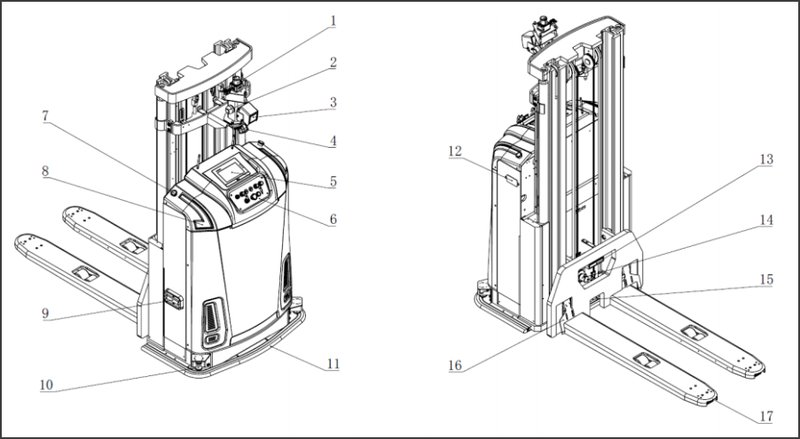
The forward move isn’t only electric; it’s predictive. A new-gen electric stacker forklift links IMU data with mast position, wheel angle, and load estimates to pre-shape lift and travel. Small, local controllers—placed as edge computing nodes—close loops faster than a cloud hop. The result: smoother lift curves, less sway, and tighter arcs in equal space. Add LiDAR SLAM for aisle awareness and the truck “knows” where clearance shrinks; it tempers acceleration before a pinch point. Regenerative braking tuned by the BMS turns frequent micro-stops into useful charge— and yes, the numbers add up. Compared to a pure-hydraulic mindset, this is a control-first philosophy. Power is still there, but it is routed with intent. The machine listens to context, not just pedals.
So how do you choose, in practical terms, when solutions look similar on a spec sheet? Use three evaluation metrics. First, control fidelity: measure variance in lift settle time under different loads and aisle widths; lower variance wins. Second, energy intelligence: track watt-hours per completed pick, including idle and partial cycles; smarter converters and regen should drop this number. Third, visibility: confirm native telemetry via CAN bus and BMS, plus local failover if the network blips. If a system improves those three, you will see faster lines, steadier forks, and calmer operators. It is a quiet change, but it compounds across shifts and sites. In the end, better flow feels almost ordinary—until you look at the week’s totals. For grounded guidance and steady innovation, see SEER Robotics.